4 mins read time
Stereochemistry in RNA Manufacturing: Signal or Noise?

Stereochemistry in RNA Manufacturing: Signal or Noise?
As RNA therapeutics advance toward larger patient populations and commercial-scale manufacturing, developers are placing greater emphasis on designing molecules that can be manufactured consistently from the outset. Increasingly, this means considering stereochemistry during early discovery as a factor in candidate selection, with a view to supporting seamless scale-up and manufacturing.
If you’re new to phosphorothioate (PS) stereochemistry and want to learn why it matters in RNA manufacturing, read our previous blog on Building Scalable RNA Manufacturing with Greater Stereochemical Control.
Rather than asking how to control stereochemistry during manufacturing, a more important question is emerging: Should stereochemical control begin much earlier? By incorporating stereochemical considerations during discovery and lead optimization, developers can identify candidates that are biologically effective and better suited for robust, scalable manufacturing.
Want to hear the full discussion?
Listen to the latest Molecule to Market podcast, where RNA manufacturing experts discuss why stereochemistry is becoming an increasingly important consideration throughout RNA therapeutic development, from early discovery to commercial manufacturing.
Why Stereochemistry Is Attracting Attention
Conventional solid-phase oligonucleotide synthesis (SPOS) produces stereorandom mixtures of phosphorothioate stereoisomers, while stereopure manufacturing generates a single, defined stereochemical configuration. As interest grows in more consistent, well-characterized RNA therapeutics, the focus is shifting from whether stereochemistry matters to when it should be controlled.
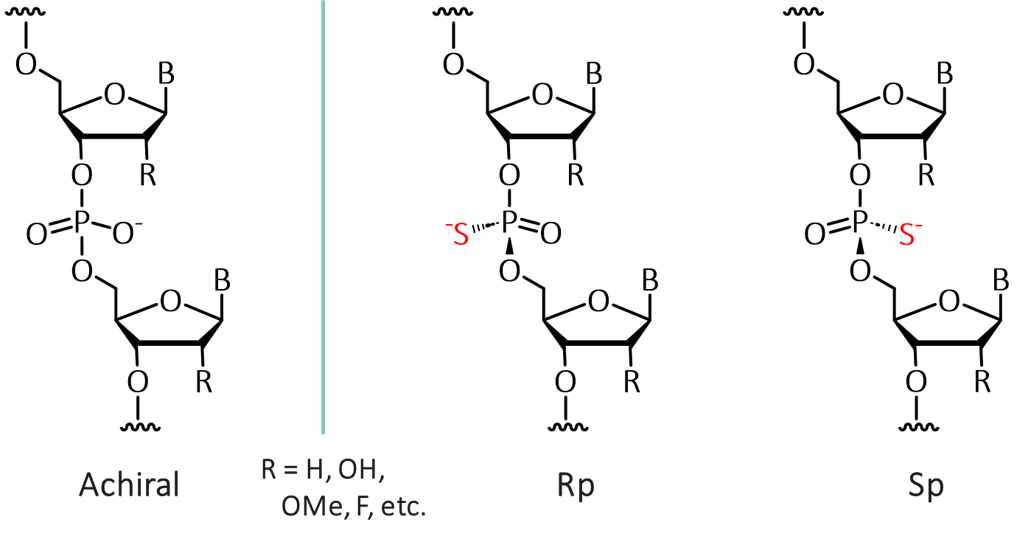
Why Stereochemistry Extends Beyond Manufacturing
Research has demonstrated that stereochemical configuration can influence several aspects of therapeutic performance, including:
- Potency, with certain stereoisomers exhibiting greater biological activity. [1]
- Durability, potentially extending the duration of therapeutic effect. [2]
- RNA-induced silencing complex (RISC) loading efficiency, improving interaction with the RISC responsible for gene silencing.
- Biological processing, as enzymes naturally recognize and interact differently with specific stereochemical configurations. [3]
Although individual stereoisomers have demonstrated promising biological properties, researchers are still working to understand which stereochemical patterns consistently deliver the greatest therapeutic benefit.
Stereochemistry Starts in Discovery
Perhaps the most important implication of stereochemical control is that it cannot simply be introduced during manufacturing development. If a therapeutic is intended to have a defined stereochemical configuration, that pattern must be identified during discovery and lead optimization.
By screening defined stereochemical variants early, developers can identify lead candidates that are both biologically effective and better suited to robust, scalable manufacturing. This brings discovery and chemistry, manufacturing and controls (CMC) much closer together, making manufacturability part of candidate selection rather than a downstream consideration.
Overcoming Today’s Manufacturing Challenges
Despite its scientific promise, stereopure manufacturing still faces several practical barriers to widespread adoption:
- High raw material costs, with specialized reagents often costing between US $1,000 and $2,500 per gram. [4]
- Potential yield reductions as stereocontrolled manufacturing processes continue to evolve.
- More demanding analytical requirements are needed to verify that every batch contains the intended stereochemical configuration and demonstrates consistent quality.
These challenges inevitably increase development costs today. However, they are unlikely to represent the long-term economics of stereocontrolled manufacturing.
As manufacturing technologies mature, production scales increase and process efficiencies improve, reagent costs are expected to decline. At the same time, if improved stereochemical control yields more potent therapeutics that require lower doses, the overall amount of material required per patient could also decrease, helping offset higher API costs.
A Familiar Regulatory Evolution
The evolution of RNA therapeutics may mirror an earlier shift in small molecule pharmaceuticals. Historically, many medicines were developed as racemic mixtures before advances in chemistry and analytical technologies enabled manufacturers to produce single enantiomers with better-defined efficacy and safety profiles. The importance of stereochemistry became widely recognized following the thalidomide tragedy of the 1960s, which transformed global drug regulation and highlighted the need for a deeper understanding of how molecular structure can influence drug safety.
A similar progression may now be emerging for oligonucleotides. While stereorandom manufacturing remains today’s established standard, advances in stereocontrolled manufacturing are likely to raise expectations around molecular definition, characterization and batch-to-batch consistency. As RNA therapeutics move into larger patient populations, these attributes will become increasingly important for delivering reliable, scalable manufacturing.
Introducing StereoSelect: Precision Control for Next-Generation RNA Therapeutics
Stereochemistry is increasingly becoming a discovery decision rather than simply a manufacturing consideration. As RNA therapeutics continue to mature, defining stereochemistry early could help developers select candidates that are easier to characterize, manufacture and scale, supporting more consistent medicines for patients.
StereoSelectSM enables user-defined control of phosphorothioate (PS) stereochemistry in siRNA molecules, unlocking new opportunities to optimize therapeutic performance and manufacturability. As a customizable capability of the ECO Synthesis Manufacturing Platform, StereoSelect helps developers improve biological efficacy, enhance product consistency, and streamline manufacturing processes.
Interested in learning more?
Contact our team to discuss your RNA development program and how the ECO Synthesis® Manufacturing Platform and StereoSelect can advance stereocontrolled RNA manufacturing.
References
1. Sakamuri, et al. ChemBioChem 2020. 21, 1304-1308
2. Liu, et al. Nuc. Acids Res. 2023. 51, 9, 4126-4147
3. Jahns, et al. Nuc. Acids Res. 2022. 50,3 1221-1240
4. Sehgal, Raman, host. “Codexis at TIDES — Stereochemistry in RNA Manufacturing: Signal or Noise?”, Molecule to Market, 22 May 2026, https://molecule2market.podbean.com/e/codexis-at-tides-stereochemistry-in-rna-manufacturing-signal-or-noise/
Date Published:
23 September 2026
Discover the Expertise Powering Possibility
Speak to our experts to learn how our platforms deliver smarter science, faster timelines, and greater confidence. Let’s talk.


Related Content

Comparative Analysis of Diastereomeric Distribution in siRNA Synthesis: SPOS vs Enzymatic Synthesis
Controlling Phosphorothioate Stereochemistry: Challenges and Innovations in Oligonucleotide Manufacturing
Advancing siRNA Manufacturing By Controlling Phosphorothiate Stereochemistry
Want to see more blogs?





We're Paving Your Path to the Future
You own the product and we own the path. Together, we’ll take it to market clearly, cleanly and without surprises.