4 mins read time
Rewriting the Route: Engineering a High-Performance Biocatalytic Cascade
Rewriting the Route: Engineering a High-Performance Biocatalytic Cascade
Biocatalysis continues to reshape small-molecule manufacturing by delivering higher selectivity, lower waste and more efficient process design. A recent collaboration between Codexis and Bristol Myers Squibb (BMS) illustrates how advanced enzyme evolution can transform a synthetic route, both operationally and environmentally, by developing a highly optimized enzymatic cascade.
This work focused on enabling the efficient installation of two stereocenters on a cyclohexyl ring for the synthesis of BMS-986278, a potent LPA1 antagonist that shows promise in the treatment of pulmonary fibrosis. The outcome was a three-enzyme biocatalytic cascade that significantly outperformed the original non-biocatalytic route in terms of yield, process mass intensity (PMI) and cost.
prove scalability, process control and sustainability across RNA production.
From Concept to Cascade
Ene-reductases (EREDs) and ketoreductases (KREDs) are highly selective enzymes that can replace traditional asymmetric reductions, which can require high-pressure hydrogen, metal catalysts, halogenated solvents and multiple purification steps to remove byproducts and residual metals.
The initial proof-of-concept (PoC) cascade was developed using an early ERED variant (ERED-211), identified by Codexis through screening of archival enzyme libraries, together with a KRED variant (KRED-P2-G03) selected by BMS from Codexis screening kits based on prior work with a related substrate.
While the cascade established feasibility, both enzymes required significant optimization to achieve process-relevant performance.
Achieving Process-Ready Performance
To translate the initial cascade into a viable manufacturing solution, both enzymes were iteratively optimized to improve robustness, efficiency and compatibility under process conditions. Codexis applied its CodeEvolver® Technology protein engineering platform to enable rapid, data-driven improvements across key performance attributes, including:
- Expression level to support scalable production
- Thermostability for improved process robustness
- Resistance to substrate inhibition at higher loadings
- Tolerance to glucose and gluconic acid generated during the reaction
- Activity and performance across a broader pH range
Process-specific challenges were addressed in parallel. For example, product formation generated gluconic acid, lowering reaction pH and impacting enzyme performance. To mitigate this, later-stage variants were evaluated under pH-controlled, process-relevant conditions to ensure reliable performance at scale.
Throughout development, these improvements were achieved without compromising stereoselectivity, which remained consistently above 99% ee and 99% de.
Performance Gains at Process-Relevant Scale
This program was a fantastic example of the synergy that can be achieved when enzyme engineering is carried out with feedback from the process development team. The BMS process team made critical developments on substrate and glucose dosing, cofactor stability and reaction pH, which, when combined with the tailored enzymes, delivered dramatic improvements relative to the original process with the original enzyme pair. Substrate loading increased from 5 g/L to 67 g/L, while enzyme loading dropped sharply (ERED from 100 wt% to 8 wt%; KRED from 100 wt% to 3 wt%). Reaction time decreased from 21 hours to 12 hours, and conversion improved from 65% product formation to 99%, eliminating detectable starting material or intermediates.
These enhancements translated directly into manufacturing impact. Compared with the original 100 kg non-biocatalytic route, the ERED/KRED cascade reduced the number of steps from 4 to 2 and increased the overall yield from 35% to 55%.
The Process Mass Intensity (PMI) for this specific fragment of the API dropped from 620 to 170, representing a step-change in sustainability performance. Furthermore, BMS analysis of the complete route to the API further reported:
- 8× increase in overall yield versus first-generation synthesis
- Reduction in isolation steps from 11 to 8
- 86% reduction in PMI
- 82% reduction in projected raw material costs
In addition, the redesigned overall route enabled the elimination of halogenated solvents and sodium azide, further strengthening the environmental profile.
Industry Recognition and Broader Impact
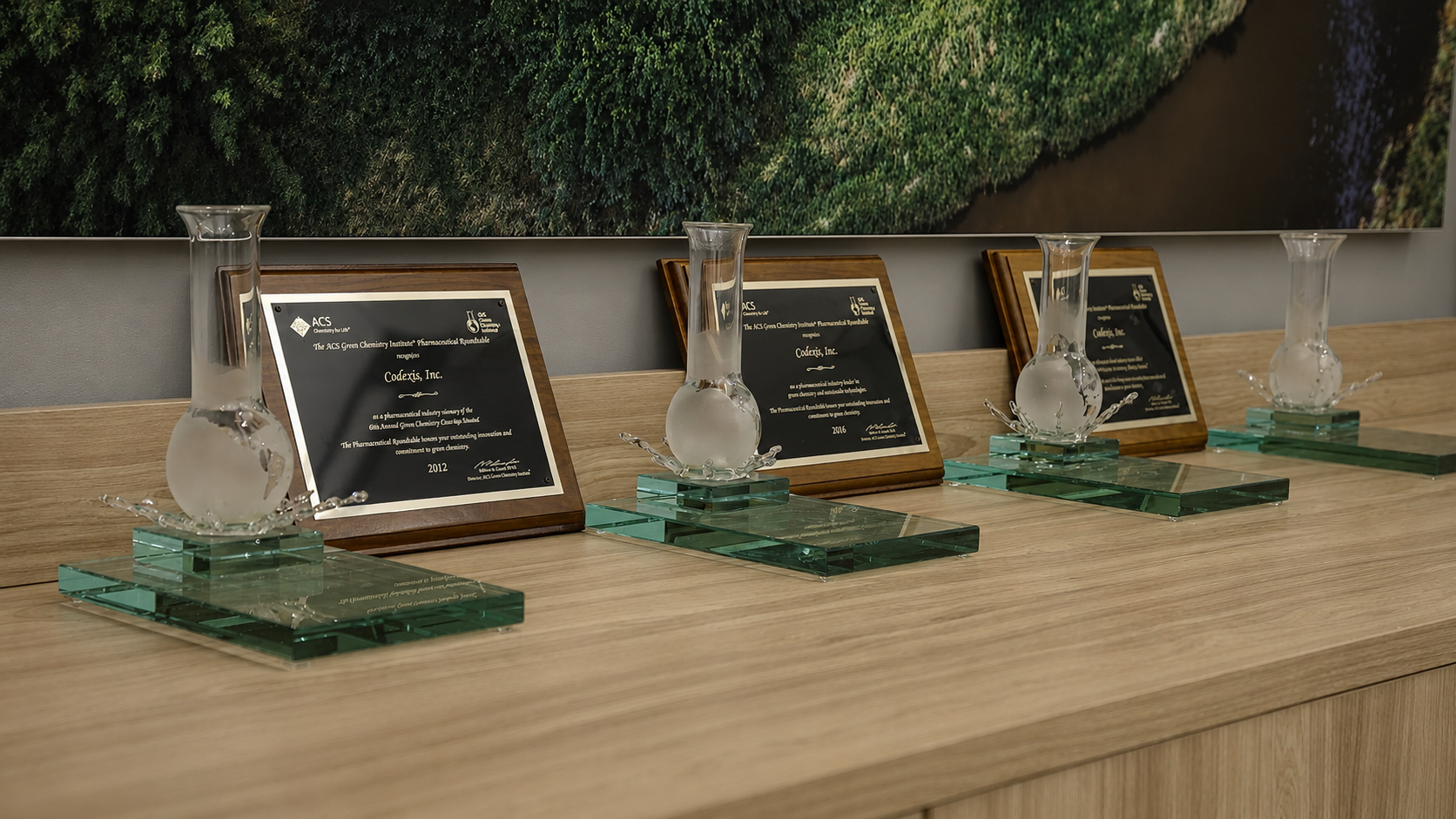
The sustainability improvements enabled by this enzymatic cascade were recognized with the 2023 Peter J. Dunn Award for Green Chemistry & Engineering Impact in the Pharmaceutical Industry.
Beyond the immediate program, the project highlights broader principles relevant to modern pharmaceutical manufacturing:
- Cascade design reduces step count and purification burden, improving yield and lowering waste streams.
- Directed evolution enables process-ready enzymes, not merely active catalysts.
- Engineering under manufacturing-like conditions is critical for translation to scale.
- Biocatalytic routes can materially reduce PMI and cost of goods at a commercial scale.
The success of this ERED/KRED cascade to make a key intermediate demonstrates how integrated enzyme evolution and process development can unlock greener, more efficient synthetic pathways. By combining high-throughput evolution, data-driven design and close collaboration with development partners, biocatalysis can move beyond proof-of-concept to deliver robust, scalable manufacturing solutions.
As the industry continues to pursue sustainability, efficiency and supply resilience, enzyme-enabled cascades represent a powerful strategy for rethinking how complex small molecules are made.
Date Published:
9 July 2026
Discover the Expertise Powering Possibility
Speak to our experts to learn how our platforms deliver smarter science, faster timelines, and greater confidence. Let’s talk.


Related Content


Enzymes to Enable a Biocatalytic Cascade for Small Molecule API
Want to see more blogs?





We're Paving Your Path to the Future
You own the product and we own the path. Together, we’ll take it to market clearly, cleanly and without surprises.