
How the ECO Synthesis Manufacturing Platform Enables True In-Process Analytics
As RNAi therapeutics move toward larger patient populations and commercial-scale demand, the industry faces a fundamental question: can current manufacturing technologies deliver the level of control, consistency and process understanding required for the next decade?
At Codexis, the ECO Synthesis Manufacturing Platform was designed to answer that question directly. Beyond enabling fully enzymatic, solution-phase RNA synthesis, ECO Synthesis introduces something long missing in oligonucleotide manufacturing: true in-process analytical control at every cycle.
From Indirect Monitoring to Direct Measurement
Traditional solid-phase oligonucleotide synthesis (SPOS) relies heavily on indirect performance indicators. UV absorbance, conductivity and pressure traces can suggest whether a synthesis step has occurred, but they do not directly confirm identity, purity or sequence fidelity at each stage.(1)
During the solid-phase synthesis process, the growing oligonucleotide chain remains bound to a solid support inside a closed column. Because it is bound, you cannot directly measure or analyze the full-length molecule until the final chemical cleavage and deprotection steps release it into solution for mass spectrometry testing. Until the analytical testing after the cleavage and deprotection step, the success, purity and exact sequence identity of the synthesized oligonucleotide remain completely unknown.
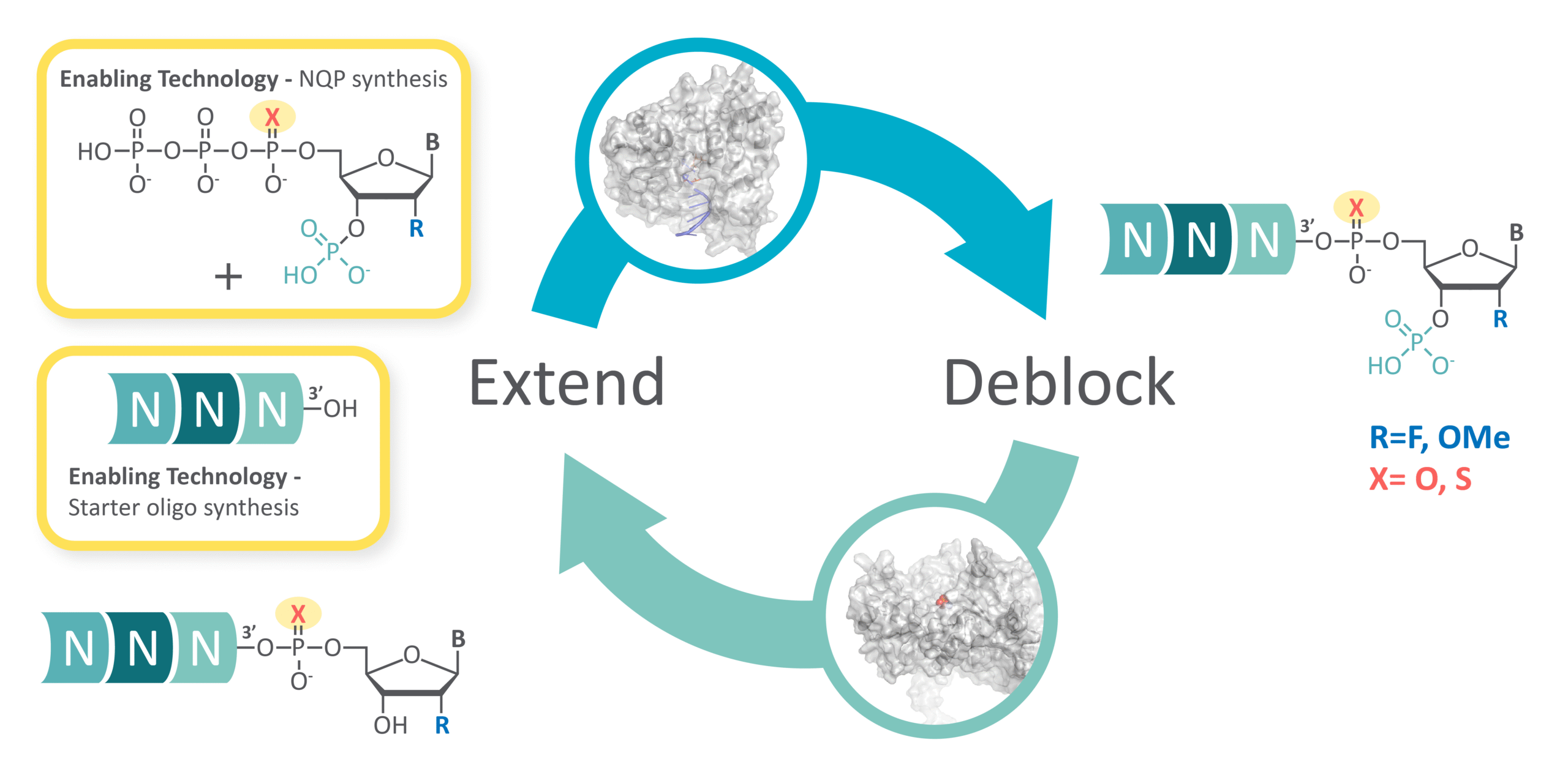
In contrast, ECO Synthesis operates in the solution phase with discrete extension and deblock steps. Because intermediates are accessible in solution, they can be sampled in real time without dilution and analyzed directly by LC-UV/MS using ion-pair reverse-phase (IPRP) methods. This enables:
- Identity confirmation at each step
- Purity assessment of intermediates
- Sequence verification before proceeding
- Confirmation of successful step completion prior to the next cycle
Rather than waiting until the final lyophilized material is produced to assess whether specifications are met, manufacturers gain continuous insight throughout the synthesis.
Building Process Understanding Through In-Process Analytics
By combining solution-phase synthesis with direct analytical monitoring, the ECO Synthesis platform can provide continuous visibility into reaction progress, product identity and process performance throughout RNA assembly with:
- Real-Time Stepwise Confirmation
ECO Synthesis enables direct monitoring of each synthesis step using ion-pair reverse-phase (IPRP) chromatography. Because intermediates remain in solution, samples can be analyzed throughout the process to confirm whether reactions have reached completion before proceeding.
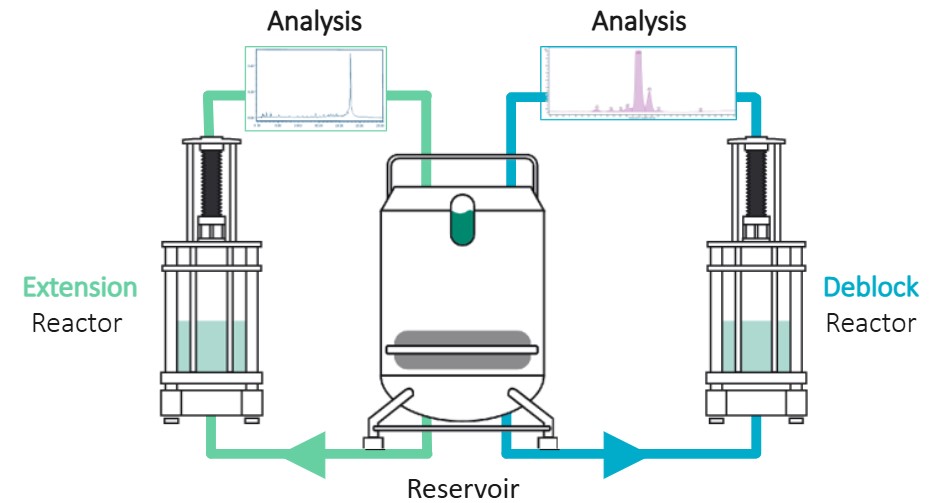
During an extension step, the chromatogram shows two peaks if the reaction is incomplete: one for the residual starting oligomer and one for the extended product. As the reaction progresses, the starting-material peak diminishes, indicating completion.
The same principle applies to the deblock step. When incomplete, the trace shows peaks for both the blocked intermediate and the unblocked oligomer. As the reaction finishes, the intermediate peak decreases significantly.
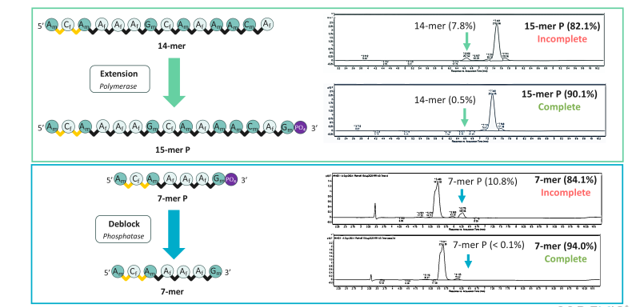
High-resolution mass spectrometry can also confirm sequence identity after each addition, enabling stepwise verification of the growing oligonucleotide and strengthening overall process control.
2. Early Error Detection and Material Preservation
Even robust processes can encounter deviations. In enzymatic synthesis, over-extension or unintended additions can be detected rapidly through in-process mass analysis.
For example, if a 10-mer extension unexpectedly yields measurable over-extended species, the issue is immediately apparent. The synthesis can be halted before additional high-value reagents are consumed. Root cause analysis can be conducted while the material remains recoverable.
In traditional workflows, such failures may not become apparent until late-stage purification or final testing after substantial cost and time have already been invested. Early detection reduces waste, protects raw materials and improves overall process economics.
3. Enabling a True Feedback Loop
ECO Synthesis also supports quantitative process optimization. Using calibrated UV data and mass spectrometry, concentration and yield can be measured at each step. This transforms synthesis from a linear operation into a dynamic feedback-driven system. With cycle-by-cycle yield visibility, development teams can:
- Identify yield-limiting steps
- Adjust enzyme loading or reaction conditions
- Optimize extension efficiency
- Build predictive process models
This aligns directly with the U.S. Food and Drug Administration’s (FDA’s) process analytical technology (PAT) framework, which emphasizes identification and control of critical sources of variability within a defined design space. A process is considered well understood when variability is characterized and product quality attributes can be reliably predicted.
ECO Synthesis is inherently structured to support that objective. Direct sampling, stepwise verification and quantitative analytics create a data-rich environment in which variability is measured and managed.
Scaling RNA Manufacturing with Built-in Process Understanding
Codexis has demonstrated gram-scale RNA synthesis using standard laboratory equipment and has advanced to multi-gram production of clinically relevant antisense strands, with planned increases beyond 100-gram scale to support toxicology and GMP-relevant manufacturing. Because ECO Synthesis operates entirely in the solution phase, the same analytical strategy used during development (direct sampling and LC-UV or LC-MS confirmation of intermediates) remains viable as batch sizes increase. This ensures that process understanding and quality control scale alongside production.
Looking ahead, these capabilities open the door to more integrated process analytical technology (PAT) workflows, where real-time monitoring and data-driven feedback loops support predictive, design-space-driven manufacturing. In this model, enzymatic synthesis and in-process analytics work together to provide continuous visibility into sequence fidelity, yield and reaction performance.
For RNAi therapeutics to reach larger patient populations, manufacturing must be both scalable and deeply understood. ECO Synthesis demonstrates how combining enzymatic chemistry with stepwise analytical verification can deliver that foundation.
References
- Cytiva. (2020). Robust and cost-efficient oligonucleotide synthesis: An application of Process Analytical Technology (PAT) (Application Note 28-4058-08 AA). Cytiva. https://cdn.cytivalifesciences.com/api/public/content/digi-14123-pdf [cdn.cytiva…iences.com]
Date Published:
30 July 2026
Discover the Expertise Powering Possibility
Speak to our experts to learn how our platforms deliver smarter science, faster timelines, and greater confidence. Let’s talk.


Related Content


Enzymes to Enable a Biocatalytic Cascade for Small Molecule API
Want to see more blogs?





We're Paving Your Path to the Future
You own the product and we own the path. Together, we’ll take it to market clearly, cleanly and without surprises.